
Here’s one remarkable woman whose story I have always wanted to share!
Charlotte Makgomo Maxeke was born on the 7th April 1874, though there is much debate about where she was born, with sources citing Ramokgopa district in Polokwane while others attributing Fort Beaufort in the Eastern Cape. There is evidence, however that her early life was spent in the Eastern Cape where she obtained her missionary education at Edwards Memorial in the early 1880s.
As dedicated churgoers, Maxeke and her sister joined the African Jubilee Choir in 1891 and toured England for 2 years. With hopes of pursuing an education, they went on a 2nd tour to the USA with the church choir in 1894/1896. However, the tour collapsed and things backfired for them.
After the completion of the tour, the European orgamizer deserted them, running away with all funds and return flight tickets, leaving them stranded and penniless on the streets of New York City. The story of the deserted South African choir members made it to US newspapers and Americans came to the choir’s financial rescue.
Bishop Daniel Pyne of the African Methodist Church (AME) in Ohio, who was a former missionary in the Cape Province of South Africa, recognized Maxeke’s name from the newspapers. He contacted her and offered her a church scholarship to Wilberforce University that she gladly accepted.
She excelled in all academic fields and graduated with a BSc. degree from the same university in late 1890s, becoming one of the first black women from South Africa to graduate. It was also while she was student here that she managed to arrange opportunities for many notable African students to study at Wilberforce including Charles Dube & James Tantsi.
It was also here, where she met her husband Marshall Maxeke who had come to the University in 1896. They were engaged when they returned to South Africa in 1901.
Their marriage was described as one not only based on love but also upon mutual, intellectual and professional respect where both strongly supported each another. The Maxeke’s returned to labour as dedicated missionaries, advocating for the advancement of educaction as the only route to a prosperous life for Africans in South Africa.
Maxeke, through her AMEC church influences, organized the Women’s Mite Missionary Society in Johannesburg before moving to Polokwane, under Chief Ramokgopa, who, after realizing her passion of education, gave her some money to start a school which was unsuccessful at first.
After this, Maxeke and her husband went on to establish a school at Evaton on the Witwatersrand, founding the Wilberforce Institute, which prospered as a primary and secondary school. The school still exists to this day!
During that period, they also collaborated on the compilation and publication of the 1st AME church hymn book complied in IsiXhosa.
Both her and her husband also attended the launch of the SANNC (which later became the ANC) in 1912, which marked their political activism phase including Charlotte’s election as leader of the Bantu Women’s League and Women’s Missionary Society years later. Both the Maxeke’s settled in Johannesburg, after spending some time as evangelists and teachers in the Eastern Cape, where they continued their political activism.
Marshall Maxeke passed away in 1928 at the age of 53.
After her mourning period, Charlotte Maxeke set up an employment agency for Africans and also became the 1st black woman to become a parole officer for juvenile delinquents in the 1930s in Johannesburg. She sadly passed away on the 16th October 1939 at the age of 65.
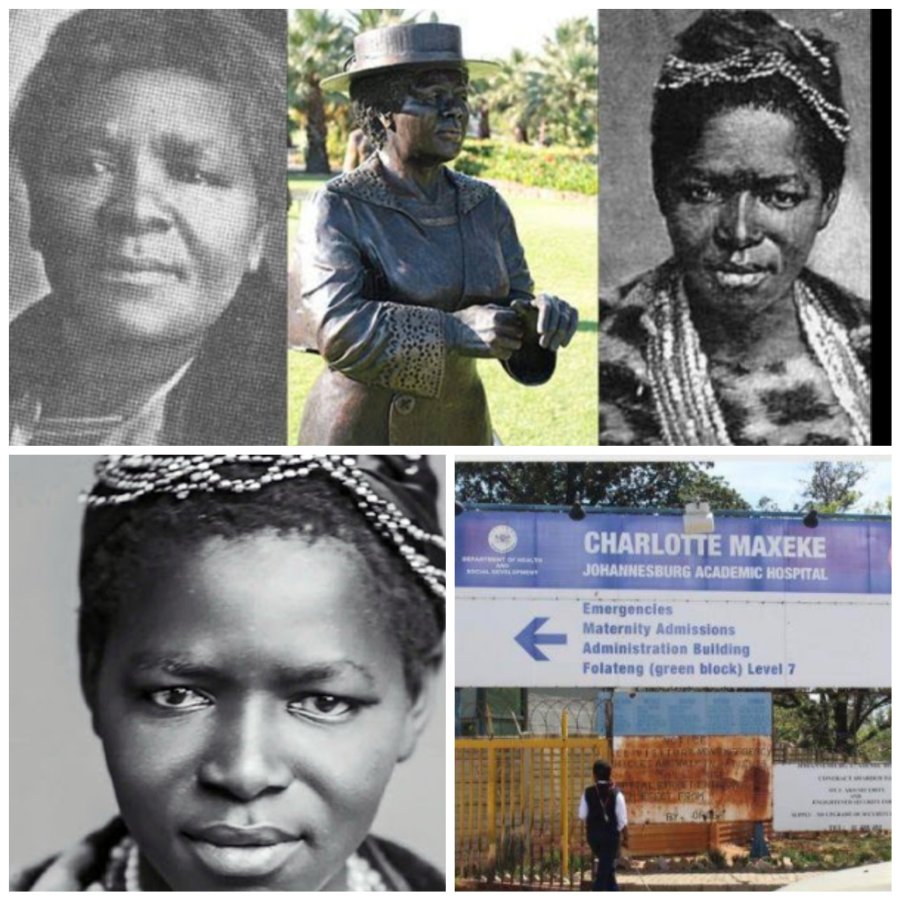
Today, her statue can be viewed in Pretoria’s Garden of Rememberance and Johannesburg General Hospital in Parktown was renamed in her honour. Mitchell Street in Pretoria was also renamed in 2012 to Charlotte Maxeke and there’s a nursery school also named after in Tanzania.
Today I remember and honour this silent hero for her remarkable story of inspiration, talent and social work – a complete all-rounder of note, who is more than just the name behind one of the voices behind the passive resistance movement and Women’s emancioation against pass laws.
Credits to a Heritage Portal Article written by Daluxolo Moloantoa & sahistory.org.za
 SithenjwaT