
Four children and all of them female – the magic number here being four. Zonke’s ‘Nomanyange‘ song has this as its opening lyrics as an intro for the song, one that always strikes a chord and hits home for me every time.
This is what sets the precedence for this piece inspired by a song titled ‘Nomanyange‘ by South African songstress, Zonke Dikana. She cleverly opened her debut album titled ‘Life, Love’ n Music’ with this very same song as it holds a unique depth of meaning to her. The album was released in 2007 under the Kalawa Jazmee record label. I usually enjoy attending her live performances and in my humble view, her band is on a league of its own and I won’t mind to personally pay a fortune to have them serenade me all day, anytime. One day though…
I have come, over time, to figure that Zonke always begins her live set with either two songs. One being ‘Ndilimpondo‘ (I am of Impondo ethnicity) from her last offering titled: ‘L.O.V.E‘ which was released in 2018. The other track is Nomanyange.
The song speaks of Zonke’s late mom and the pain that she endured in raising her four daughters, at a time when it was seen as a crime to give birth to only females as your children. I am reminded of the pain that princesses go through when it comes to taking over the throne whenever there is no elder son alive, the thought that by birth right, it can only be males who are entitled to such esteem positions. This can easily work on one’s psyche. Historically, culture has always shared and held this view to a regard, one that requires us to converse broadly about it. But, for now, will park this perspective aside for another piece.
‘Nomanyange‘ speaks to this current reality we now find ourselves. In the song, she speaks of how her mom went from pillar to post, to fend for her daughters to ensure that they have a secured future. ‘Ndawa ndinvuka nezam’ Zonke. Babala. Bakhuza, ngengxa yez’itjatjambo zam‘ (She went down and she rose with all her children. They counted, they reprimanded her because of her beautiful flowers). She speaks in disappointment of how many people close to her mother at the time, were quick to reprimand her on the so-called bad omen that she has casted upon herself with giving birth to only daughters: ‘Babelapho bonke besithi kuye, babe lapho bonke bem’khalimela. Bethi lithumelo.’
How tragic… to think that there are some amongst us who still hold this view to this day.
Nomanyange saw her daughters as her flowers in the song. That’s what she saw when others saw little girls who will not grow the Dikana family name. Zonke now boasts about being a proud and exemplary product of the parent who they sought to pin down. She now stands tall as one of Nomanyange’s daughters as one of South Africa’s most successful female music artist.
“Bambiza amagama, bambiza isiheleku, wathwalwa ngubani na? xa esenz’abantwana, abangekak’thwal’ gama, abangakuthwal’usapho” (They called her vile names, who even gave birth to her? When she would grow to only give birth these daughters (of hers) who won’t grow to carry the family name. They won’t grow the family). These are the lyrics, translated from isiXhosa. She reiterates how her mom was tortured and made to feel less of a woman, let alone a human being for giving birth to her beautiful girls.
To bring the song closer to home. I remember two women in my life, who were also subjected to a similar pain, ridicule and pressure from raising (mostly) girl children and children who were born outside of wedlock. My late grandmother, Violet ‘Lyza‘ Nozinja Mzila and my mother, Johanna Mzili. These two are who my mind easily recalls each time, Zonke speaks of Nomanyange in her song.
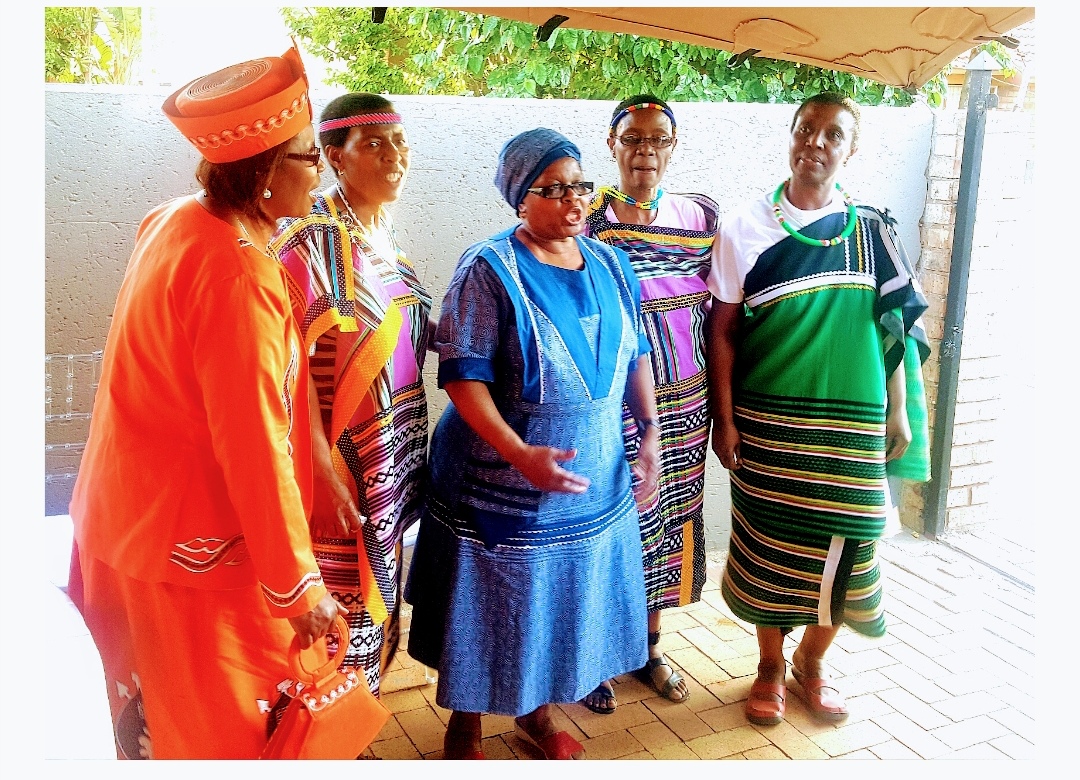
My late grandmother gave birth to four daughters and a son. The son, my uncle, sadly passed on when I was only 3 years old. Her daughters; non-identical twins as first-borns, then my mother, who came after the twins and the last born, my aunt, who in my language we call Mam’ncane. In that order. Those are Lyza’s daughters. I must say, I found it such a hassle to get a picture of all four of them at once but the cover pic, came closest to what I saw would suffice, minus the woman at the middle with a blue Seshoeshoe attire. All four of them are on the pic.
Each time, I listen to Nomanyange, I remember the pain that my grandmother also went through from the stories I hear shared about her by my mom and sisters, time and time again…
How raising her daughters under trying times, was her constant reality. How her daughters were denied, how she was sent from pillar to post when she tried to do right by them. How she persevered to raise them, the best way she knew how. She, too was ridiculed for the many daughters she gave birth to, insults more piercing the passing of my uncle. The fact that my grandmother had a different ethnicity to my grandfather, was also a big talking point. My grandmother’s complexion as well is a story on its own. Everyone from my grandmother’s side of the family looks completely different from us due to their very striking light skin and tone. My grandmother was born from a white Afrikanner man (only known to me as Mnr. Grootboom) and a Zulu woman (MaShabangu) which explained her striking light skin tone. My grandmother then had children with a Tshivenda man, my late grandfather who we affectionately referred to as Oom Willie. May their souls continue to rest in peace.
A Zulu woman, having children with a Venda man, in those days, was completely unheard of. You can imagine the backlash she received with trying to reclaim her children’s birth rights and roots. The similar occurrence happened which gave rise to my generation of the family tree and myself in particular. My mom, who is Venda, had myself and little sister, with a Zulu man (my dad) – an interesting combination. I try to ask her how they met and the story holds truth to how love or association knows no ethnicity or language barrier.
Zonke reiterates the significant role her mother played in their life when she sings praises to her at the onset verse of the songs: ‘Ngonyamakazi yam (my, of royal, highness/lioness/queen), Ngonyamakazi yam‘. She reiterates this important part of the song about six times. I also got the chance to be part of the live audience when she recorded her DVD for her successful album ‘Ina ethe‘ (give and take) at Gold Reef city’s The Lyric Theater in 2013. When she recorded the album, she was intentional on including some of her most popular songs that contributed to her growth to date; songs that included ‘ekhaya‘ (home), ‘uzondilinda’ (you shall wait for me) & ‘Nomanyange‘. I was struck by how powerfully and passionately she performed Nomanyange as part of the opening to her second set of the DVD recording. It was on the verse when she says ‘Ndim’ lo, Ndim’lo (Here I am, here I am), Nguye lo, Nguye lo‘ (There she is, there she is). And it is at this point (at exactly 04:00 mins into the track) that she is seen pointing to her sister, the late soulful songstress Lulu Dikana, who was also part of the audience.
Then, another verse that immediately sends me back in time, is when she says that her mom could not take the insults and hauls aimed at her any longer, ‘She, couldn’t take it anymore, not a day longer. There ain’t nothing wrong with my babies (she said), I’ll take them and I will leave.’; the verse reads and there is great power, courage and a story behind this that puts the listener into the life of and brave acts and character of her mom. It reminds me of the stories I hear when my grandmother battled to raise her daughters after they were denied due to the ethnicity questions that came into the picture. This then led her to stop trying to force relationships but to resort into raising her children all alone, away from all the insults and people that hauled them back at her. She became independent, relying on herself only to raise them. She got them a decent roof over their heads for them to call home.
This is how our popular family house, kwa gogo (our grandmother’s house) in Diepkloof Zone 5 came to be. The house still holds a significant place in my heart as it is where I grew up and spent most of my early childhood years, being raised by my grandmother while my mother had to work. I remember those moments; her holding my hand during that horrible pre-school graduation, getting the help of our family puppy ‘snoopie‘ to discipline me into form. Snoopie used to literally fetch me from the playground when it about to be night time and he’d rush me all the way into the yard. How she was always there to make me breakfast, ensure my uniform is clean and prepared before I took my brief walk to school. I was lucky to go to a pre-school at Thabisile Primary School, which is located a stone’s throw away from my grandmother’s house. I have never had the privilege of using scholar patrol, which is a buzz word these days with school children. I remember those moment vividly, like they took place just yesterday, each time I listen to Nomanyange.
My mother also had to do the same with raising us. She got tired with running around, begging people to help her raise us or force them into accepting us as legitimate children. She stopped; took a decision to get herself a house and raise all four of us alone. There comes that magic number again, four. This time, applicable to me and my siblings – an older sister, brother, myself and then my little sister. All of us can attest to how impactful this decision of hers, back then, was to where we currently find ourselves in life. We’re more wiser, cautious and confident in more ways than one, independent in thought and steadfast. I always advocate for the referral to inspiration closer to home than outside as someone who is right in front of you makes a greater and lifetime impact than famous or influential people out there will. There is no better example of inspiration than within sight, right in front of you and from home.
To this day, my mom and her three sisters are united still supportive of one another. They make life decisions together, regularly consult and caucus whenever big family events or rituals need to be made. How I wish that this type of relation and united front to be passed on to my generation and those still to come…
A beautiful tribute to a rock. It’s amazing how common these stories of hope are and how they cut across ethnicity and people. How many, including myself, resonate with this.
It’s true what’s said about the beauty existing in a storm. As one comes out of it, they come having experienced life through a different lens and come out, completely different than how they were prior. I look back at my own life now and take it all in, because all those experiences that I have recollected have culminated to the person I am today. I look at Zonke and her successful career and I am left with nothing but awe, for all the experiences that she witnessed have worked together to lead her into her own sense of worth, glory and light (together with her sisters) and attests to this when she sings, ‘Ndim’ lo ndingomnye wabo. ‘(Today, here I am, as one of those flowers).
Well, I’ve said a mouthful, let me listen to this song once more.
 SithenjwaT