
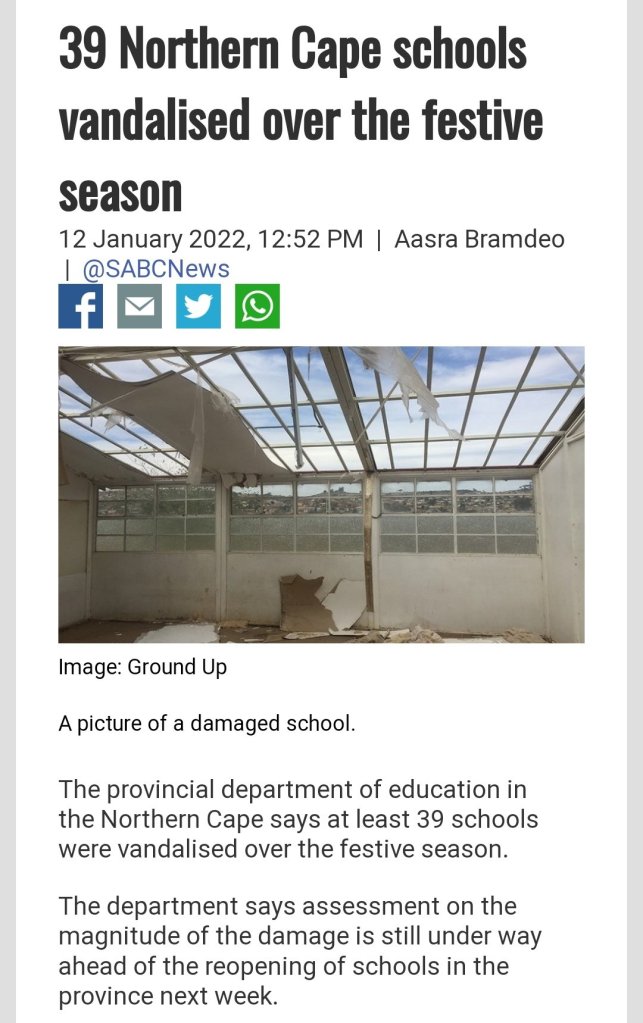
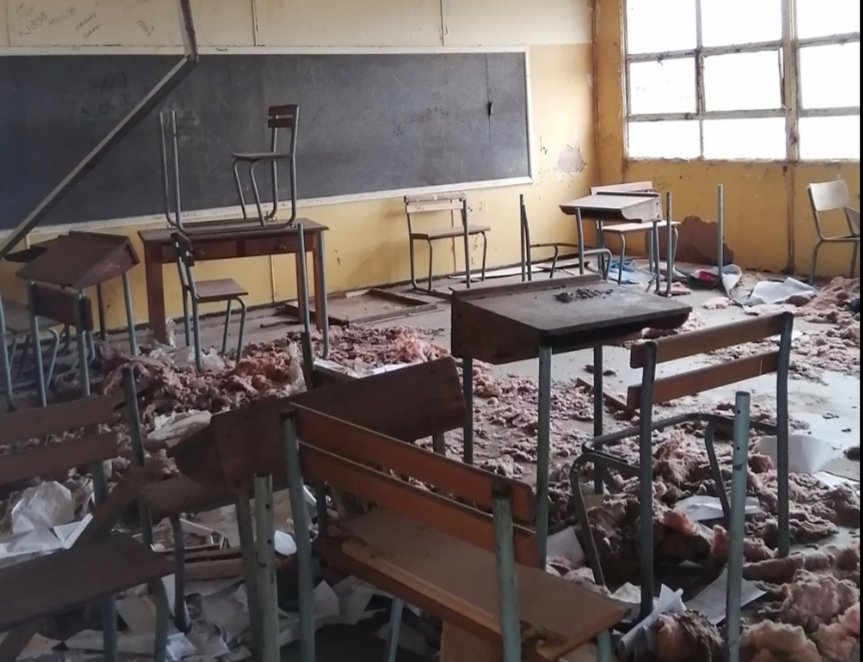
Instead of school bells ringing and scores of little ones nearly dressed in their various uniforms rushing to line up for class, it’s the sound of dead silence and vacuum that engulfed many schools in our country as the new academic term began this week. Empty classes, damaged walls, broken windows and seals, stolen equipment- a sight that no responsible and concerned education stakeholder wants to see or hear about, especially on the first day of school in the year.
Inland provinces schools opened this week Wednesday, the 12th January 2022 and although this brings some bit of normality from the festive break, I am certain that school vandalism is an abnormal act. I must also admit that I am not so sure why coastal schools get a different opening day (often a week later) when compared to inland provinces? That’s something I need to research to better understand reasons for it but I am glad that, in any case, schools are back in operation in the country.
Well sadly, not all schools.
Covid-19 lockdown restrictions have imposed serious restrain in Angola for instance, where schools are reported by africanews.com to have been closed for close to a year. It is further reported that nearly 40% of children from East and Southern parts of Africa are not in schools as a result of Covid-19. The statistics reveal only 12 out of 21 countries have schools fully open, according to News24. It is scary to think of the long-term impacts on these missed school days even though the rise in online teaching has somehow sought to close the gap, there really is some danger with not having children physically in schools. This is also dependent on your thoughts on the matter but a number of educational specialists often talk about the social impacts that this has and the reality of there being many parts of the world where the necessary infrastructure for online learning and teaching cannot be feasible if not possible without any glitches. There is also some data and internet connection costs to online learning, and not all parents can afford that. So in as much as virtual learning is the new buzz word, there is a whole community of learners across the globe that are left behind and negatively impacted with such a medium enforced as a norm.
This week, it is reported that around 39 schools in the Northern Cape Province were vandalized over the festive period (refer to the SABC News reference link). One school in the North West Province, close to where I am based, has been vandalized about five times and parents have voiced out their concerns through protests along a major provincial road to send a strong message of frustration to the department of basic educations delayed response to the matter. It is also concerning that people often find the protesting route as the only means to which government can lend them an ear. Government often takes time to listen and respond to the cries of the people to such an extent that they resort to demonstrations, which are protected as part of our constitution. Some find this avenue effective in getting the attention of the people, but it worries me if it gets violent and leads to the damage of goods and property.
I also had my fair share of such an experience this week, when I had to leave work late due to a strict deadline that we are currently working against. I often leave work late and have not found much hassle en route home. This week on Thursday, we were met with road closures on both sides of the entrance to my place of work, essentially leaving us stuck at the middle on our way out. The community was protesting against basic service delivery, general disgruntlements and high unemployment in the area amongst many issues that I could source out from enquiring on reasons behind the road blockages from the gatherings. What concerned me was the fact that they were protesting to get the attention of the private company I work for and not to the royal council or local government, which I believe to have made sense although I know the intricate issues of all these sectors where my current employment concerns.
Thankfully, it was not violent, from what I could observe. I simply did not appreciate the fact that we were kept away from going back home to our loved ones late at night, for no valid purpose. I was able to get out of the blockage using the help of one of the locals who helped me navigate a quick way out to the nearest main road. Luckily to me, this has only happened once and I am not sure if this is only the tip of the iceberg as the year progresses but I digress.
Back to the matter at hand: school vandalism.
So many children across the country could not go back to school as a result of vandalism this week. Think about that for a second – the dire impacts and implications thereof. Why would people do this, who could have done this and for what gain/benefit? Is it even justified? These were some questions I constantly asked myself when listening to the news clip and it simply does not make sense to me.
A school and its infrastructure, although the property of the state, collectively constitute an important facility for the community. The many learners who get a basic right met there, teachers and staff who are employed there, parents who get a relatively safe space to send their children to and the community at large, who can boast to have such a property to call their own, depend on its existence for one reason or the other.
Our government has a number of flaws but in some instances, particularly where public schooling education is concerned, there are a number of great stories to tell. How money is invested into education to enable thousands of learners to attend school without paying school fees, how good health and nutrition, books and stationery are also offered free of charge to learners who would in a normal instance, not be able to acquire these. With the need to adapt to change and globalization requirements, a number of interventions including improving access to computers, fibre internet and smart boards for both teaching and learning to take on new forms and build on the unlimited knowledge reach are also now a reality. These are now possible in many schools of our country today. Equipment for learning an teaching needs to be respected and protected. It’s shocking how communities seem to be turning a blind eye to the role that a school plays in the society when acts of vandalism are reported. Why is it that the traditional role of a school seems to no longer be recognized in our societies?
As a result of these acts of malice and damage, money will be required from the state funders to attend to the repair costs, which can take weeks to months to get back to normal. What then happens to the learners, who will now miss school, as a result of this? What gets to done about them? Who speaks up for them? Who calls out these acts of theft for what they truly are? Who needs to stand up? Shouldn’t this time call for this?
Is there something that can be done to prevent these? I believe there is.
1. Call these acts out for what they are.
It helps no one when we go around sugar-coating and attempting to find reasons behind acts of vandalism in schools. There is none, that is valid. Theft is theft. Theft is wrong and as such, the full might of the law needs to take its course and those responsible for these acts need to be found and punished accordingly. Moral regeneration is a good starting point and as a society, we ought to bring it back to that and start there as a means towards rectifying such ills.
2. SGBs to take a firm stand.
The South African Schools Act (SASA) no. 84 of 1996 under Chapter 3, sections 13, 14 and 20 (refer to link and download of the act on the references) provides guidance in terms of the safeguarding of school equipment as a responsibility of school governing bodies (SGBs) amongst other stakeholders. SGBs need to reclaim their power, take a firm stand and act decisively against this scourge. SGBs need to prioritize raising funds for protection services through security gates, additional personnel on guard, panic buttons and alarms to mention some examples. They need to also put pressure, where applicable, to the education department through its provincial structure for appropriate budget allocations to be used for securing assets. The SGB also needs to hold school management to account on the overall education at the school. SGBs need to be more vocal and must act against vandalism in schools through strategic school improvement plans.
3. State to make budget provisions for security.
Instead of overspending on unnecessary items like a bloated cabinet, corruption due to alleged state capture and all other examples where money laundering and wasteful expenditure has been reported from the State, why not redirect it to schools and insisting on boosting securing and protecting not only the assets and education but also, the lives of the many teachers, staff and learners across our land, vulnerable to all sorts of crime and harm? If this can be well thought out and carefully implemented, monitored and a report back given to the public, I am certain that this would be seen as welcomed relief. Not that educational provisions are not done at the moment in the country, but a need for more of these in strategic places and instances in and around our education sector or through reinforcements, could go a long way in addressing vandalism in our schools as a ripple effect.
4. Communities should stand up.
Schools are never located in islands. They are part of a community and environment which houses it. It is never simply a building. Each community is unique and has its own heartbeat, fabric and identity. One thing that makes South Africans great, is the beauty that lies in common voices from all walks of life, uniting and speaking the same language of ‘enough is enough’ and being proactive about it. Community members need to come together through structured forums where they can set up patrols around the neighborhood to attempt to put an end to this. There are numerous examples across our land where such community forums have yielded incredible results for safety and security overall. This cannot be done by one person or a select group of people but can be achieved through a collective and it’s high time communities take back their power and protect their schools. This is not just for us, but for the future of our little ones who rely on the schools to offer them a hope at a possible better life. There are many livelihoods dependent on the normal operations of a school such as informal traders, school transporting services, tuck shop owners, suppliers and education assistants for example that rely on schools to earn and maintain a decent living. If schools are shut down temporarily, what happens to these individuals and where do they look to? How will teaching and learning catch up on this lost time? I am asking this question to all affected communities. It’s time to stand up.
Lastly, we all need to stand up and refuse to be characterized by such acts. We need to be accountable for our actions as people, not to take the blame but to appreciate how our acts either as individuals or as part of a group, have a ripple effect to many other people. We need to unite over vandalism and take a firm stand against it through the engagement of law enforcement and establishing community support and patrol units. It’s the only way we can salvage what we’ve got and what’s left and preserve it for future generations. The time is now.
It’s high time we give our schools, the much-needed esteem, respect, holistic support and security that they deserve. Schools are more than just buildings in our communities. They are far more than that.
References.
39 Northern Cape schools vandalised over the festive season
Ohttps://www.news24.com/news24/southafrica/news/north-west-school-vandalised-for-fifth-time-since-march-2020-20220106
https://www.africanews.com/amp/2021/02/11/primary-schools-reopen-in-angola-after-11-months/
 SithenjwaT