
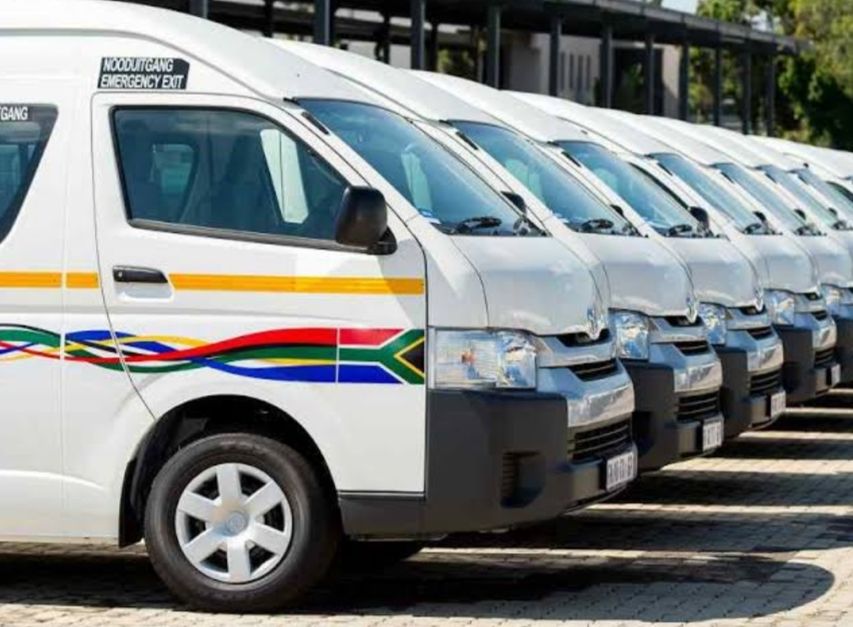
Boarding a taxi in Mzansi offers a unique experience – can be therapeutic or disastrous, depending on the journey and situation. We refer to taxis in Mzansi colloquially as ‘Amateksi‘, ‘Siyaya‘ ‘Iveco’ or ‘Quantums‘ depending on which part of the country you are based. A recent craze on social media depicts the risky behaviour often undertaken by taxi drivers when they have passengers, such as driving straighy in on-coming traffic, their horrific conditions and states at times. This, I must add, does not apply to all public transport taxis of Mzansi. I need to put that disclaimer out, upfront. These videos posted on socials are cunningly and appropriately accompanied by local gospel sensation, Lusanda Spiritual Group’s “Sobonan’emathuneni” (translated to: we shall see each other at the graveyard) soundtrack. I believe that the pairing of the song with the videos posted is a brilliant concept and that Lusanda Spiritual Group ought to be rewarded for that association.
What I also like, ironically, is that it puts the spotlight back into the dangerous situations that commuters find themselves in, on the roads, with the hope that necessary authorities effectively tackle the contraveners. I am hoping that it drives the message home for safety on the roads and reduces the growing carnage, particularly since we’re approaching the long Easter break here in South Africa.
What I’d like to write to you about here is the many interesting observations that taxi passengers witness as part of day-to-day commuting. This is a conversation that was sparked following a discussion I had with the team at Lebone Rivoningo Developments after our monthly mentoring session held on the 12th of April. I felt the need to unpack and provide a broader perspective to it.
1.Taxi Accountant
There is this untold rule about boarding a taxi that sees whoever sits in front and at the middle, automatically appointed as the taxi accountant. As each row collects the taxi fare, they then pass it forward until the front and then the taxi accountant, gets to gather it and sort out the change for passengers on behalf of the driver. The accountant must then issue the taxi driver with the full amount as per the passengers in the taxi. There are some drivers who take this task on their own, however there is a growing tradition that puts the task firmly on the front middle seat occupier. The reason behind this is to limit the distraction from the driver to enable him or her (in Mzansi it’s mostly males who are taxi drivers although there are female taxi drivers, in minority) to focus on the road. The front, middle seat is most often occupied by a female and the traditional reason behind that is based on safety. There are instances where males are also seen to occupy that seat, so it’s not that it’s unheard of. So, the next time you sit in front in a taxi – make sure your Math’s skills are sharp or that you have a calculator app ready to assist you. Did I mention that there are some areas where in one taxi, there is more than one common fare paid? Almost everyone gets a unique amount to pay based on where they are getting off or being collected from? That makes the accountant’s job more difficult, Ching, ching!
2. Window dictator
The person who sits next to a window in a taxi, automatically gets control of the opening and closing duties of the window. At times, the passengers next to the window can kindly ask the person to open or close but the decision always lies with the person who’s seated next to the window. You find a situation where the window will be closed even when it’s stuffy inside the taxi because of the window controller’s preference. The angle at which air blows while the taxi is in transit, affects the people either in front of or behind the window. So, there must be careful attention given around the window – it can easily get messy if the situation is not properly managed. Still on the subject of windows – taxi drivers are incredibly sensitive with their windows. You may have done a new hairstyle on a particular day – be it a perm or s-curl with the signature spilling styling gel – but make yourself a favour by not putting your head against the window to rest or lean. It won’t end nicely for you.
3. Size does matter
The back seat may be notorious for not being the popular spot to sit but one of things that makes size an issue for the back seat is how uncomfortable it gets when three, relatively bigger-sized individuals are seated together. When three of such individuals are seated, there is often this untold rule that will see the driver or taxi marshal carefully scrutinizing the people in the taxi to select the most slender one to complete the passengers at the back, This slender passenger is asked to vacate their seat, because they’d be already seated, to go occupy the small, gap at the back row. It often comes as a request but at times, feels more like an instruction but it really does inconvenience the person who’s asked to relocate. When that person moves, there’s often a bit of the tension which sees the three other people who are seated, always asking the fourth person whether he or she is comfortably seated or not.
4. Let’s gather the taxi fare
So in the taxis I’ve used, it’s common that the money is arranged and collected in rows. I’ve been in taxis in the KZN province where the money is collected as soon as you embark so that it clears that tedious task away. So, there is usually one person who volunteers to collect the money and takes on the task to dish out the change as required, depending on the money at hand. As soon as the money is gathered, that one person also ensures that the money is passed on to the row in front, all the way to the Taxi accountant. I will touch on how this passing on process is done shortly.
The person who gathers the money in the row, takes on another responsibility that is often unsaid. If there is anyone along that row who requires change, there is usually a whisper from among the row occupants, directed to the person who collected the money, on whether the change has been returned or not. Oddly enough, the person who requires change hardly ever asks the driver or the taxi accountant themselves. The person who gathered the row’s money has to now follow up. I find this very weird.
In the row as well, there’s usually some tricks that are done when exchanging the cash such as giving up a rand to get R10 change if one paid using R20 for a R9 change, amongst many others that take place to across the rows – all in a bid to simplify the ease with which the money is gathered. Some people even master this – it’s an art. There is always that one or two instances when people who are travelling together are found to not be sitting together, that the money does not really go in order along the rows. You find an instance where one person would go ‘Someone will pay for me.” When it’s time to gather the taxi fare. This often leads to missing total money that sometimes causes chaos for everyone.
5. Time to pass on the collected money
As mentioned previously, money in the taxi is collected in rows and it is then usually one person who gathers it and passes it on to the row in front. There is often an uncomfortable encounter here, where the person who’s gathering the money now needs to ask the person sitting directly in front of them to take the money and pass it on. This is always preceded by a “Sorry” and or a tap on their shoulder before acknowledging by the offering of a hand to receive the money. This tapping of the shoulder gets a bit uncomfortable at times when it’s done harshly or in a tough manner and that would lead to a quarrel or instant ignorance from the next person, in retaliation. This prompts the option to try someone else seated along that row as an alternative. Here, the moral of the story is being gentle and respectful to the next person when the money is to be carried forward. That often does the trick or run the risk of being ignored or get into an unnecessary argument for non-adherence.
6. Missing taxi fare – Driver’s revolt
Oh, here’s another big one – the driver must receive his or her full money during the trip and if that’s not the case, chaos and pandemonium can ensue. This can get messy. I’ve heard of stories where the driver immediately stops the taxi at the side of the road to address this and if it’s not resolved to the driver’s satisfaction – the driver would then make a U-turn and go back to where the taxi started the trip, usually at the rank. Imagine! So, pay the full amount and have a witness next to you to be safe from the drama or else, you may be the reason why the taxi returns to the rank. On the other end, it’s important to insist that passengers must ask for their change, not matter how small it is. It’s only fair, because once the driver’s money is short, there’s a lot at stake.
7. Eating in the taxi
Hunger does come in unexpectedly when inside a taxi but there is a no eating rule that applies, unless otherwise stated. A pie for example is one messy food item to eat and one needs to be delicate, strategic, sneaky and brave to chow one in a taxi. I personally don’t like it when someone eats in my car as a passenger unless it is requested and depending on the mood I am in, I approve of it. It’s better to ask the taxi driver first or any driver for that matter, for permission before you gobble anything or risk being snitched on by someone notifying the driver or the smell of the food item being eaten, giving it away to everyone. It’s also not courtesy to eat when others aren’t eating in my view. I’ve seen people refused entry in a taxi because they were still eating. Just avoid eating in a taxi to be safe, I am not sure what happens when a taxi is travelling long distance. Maybe a pitstop is made en route for a quick bite or maybe some provisions in that case are made?
8. Taxi re-route requests
Taxis usually go a set and dedicated route but there are instances where there’s a passenger or two that request a re-route – sending the taxi to a different way from the normal. In Soweto, where I am from, taxis going to town usually go via the Soweto Highway through the Booysens area into the CBD. There are cases where a passenger can request a “Via Fordsburg” route which will take the taxi route away from the Booysens area to Fordburg and then Joburg CBD. It causes some delay and all that the passengers can do is to be patient and go with the flow. They don’t have a choice in the matter unless the driver arranges for another connection taxi for those passengers halfway. There are also cases where the taxi going to Joburg from Soweto gets divided with passengers either going to Noord taxi rank or to End Street. Most of these splits are done at Booysens upon the requests of the passengers and if there is no special request, the taxi automatically goes to the Noord taxi rank. You must be quick when the change+over is done or else you can be left stranded. At least taxis accommodate special requests, which must not be abused. If people want to behave like divas, they’d rather opt to either use Uber or Bolt. Also, just let other passengers be!
9. Passengers as part of the problem
In as much as taxi drivers are well known to be terrible drivers on the roads, what is not often spoken much about is the role that passengers play in that behaviour. A driver will be driving slowly, which is not common, and passengers will request the driver to put a step on the accelerator because they may be running late for work or wherever they may be going – causing the driver to start driving like a mad man to not let down his clients. When the taxi is stuck in traffic, at a double lane road, it’s often the passengers who prompt the driver to make use of the yellow, emergency lane or to make their own new lane in the hope of avoiding the chock-a-block delay. There are instances when a passenger would say “Before the robot” or simply, “Dankie (thank you) driver” on the spot to disembark, prompting the taxi to stop suddenly, causing immediate road rage. Next time you honk at a taxi, take a moment to appreciate how it may just be the passengers at fault. Some passengers love the thrill of speed, others prefer it slow, this often divides the taxi – the onus is on the driver to do what is reasonable and to get passengers delivered to their destinations, safely.
10. Taxi therapy
Our mental health matters and it is often said that talking is one way of addressing that aspect of our wellness. Taxis are also one of the best ways to meet new people and to talk freely to strangers in the light and hope of letting things out. It’s rare to find a taxi journey that goes on silently especially with no sound system active in the background. Taxis without a solid sound system are a good therapy vehicle. People start to talk and the conversation, often loudly articulated, gets everyone listening and involved – we get hooked. Conversations range from personal matters to politics; sport you name it – one always finds a couple of people sparking a debate and this prompts instant feedback and engagements which go a long way in making the journey pleasant and worthwhile. Listening to others opens up perspective and one can easily learn a thing of two from merely listening to the conversation. Some taxi chats are hilarious – getting almost everyone in stitches instantly. Some conversations are so deep and interesting that you forget how long a ride that taxi experience was and you see how disappointed everyone gets when that person who’s narrating that story disembarks without properly closing the story that was being shared to everyone in the taxi. Many of these storytellers in taxis are extra – animated, with a strong character and personality – very confident. Talking things out helps and there’s no better way than to talk about those issues that are bothering us to complete strangers in a taxi. It’s a free counselling session after all.
11. Sleeping in the taxi
The taxi ride can be pleasant and long, leading to fatigue that triggers rest, or it may simply be one of those long days that see you needing to take a quick nap in the taxi. Well, there is no standing rule on sleeping in the taxi, but it comes with pros and cons. You need to wake up in time before disembarking or run the risk of missing your disembarking point, which could be embarrassing. Falling asleep in a tax can be uncomfortable as the space is limited, it’s not a first-class experience that will see you having to make a quick plan at how you doze yourself off appropriately. Be careful of not using the next passengers’ shoulders as head rest, unless you’re travelling together or are acquaintances or you’ve asked the other person, and they have gladly agreed to allow you to because that can be awkward. If you’re the taxi accountant though, you are not allowed to sleep as that is said to cause the driver to somehow, also fall asleep, leading to a risk for everyone. You will be reprimanded by the passengers. I have witnessed a case where the poor taxi accountant was constantly falling asleep and the driver stopped the taxi at the side of the road and asked the taxi accountant to swop with another passenger, and it was done. Imagine, having to do all that hard work in tallying the cash for the driver, to be swopped because you’re exhausted? Life can be unfair. Yes, sleeping in a taxi can cause unnecessary drama. I’d suggest you sleep or nap only when you get home to be on the safe side.
12. Dis-embarkment time
Some places where people disembark from the taxi are interesting. You find a person who is sitting right at the back, being the first one to get off. That causes almost everyone to get off the taxi in the aim of making space to enable the person at the back to disembark. There is really no better way to get around this but to take it as it comes and act as if there is no issue. I know of a place along the R558 towards Krugersdorp where passengers in taxis like to disembark at called “Ematayereni” (the tyre place) and when one looks around the area, there is no sign or sight of a tyre, yet drivers know that spot very well. The story here is that; a long time ago, there was a popular gentleman who used to fix tyres at that same spot years back. The business is now no longer there but the memory is etched in taxi passengers to this day. There’s another place, close to home that people used to call ‘The big tree spot‘ – and yes, that tree is no longer there. Going to my late maternal grandmother’s place in Diepkloof, Soweto, where i was born and raised, from eMndeni – there is a popular spot in Zone 4 called ‘Enkomeni‘ where people like to use as a landmark to disembark. Apparently, a cow once ran away and got loose at that area, back in the days and drew a lot of traffic and attention. I have never really asked what eventually happened to that cow to be honest. Besides the classics – ‘After robot‘, ‘Passage‘, ‘Short left/right’- nearby buildings are also used as landmarks but the one that cracks me the most is simply ‘ Dankie driver‘ – which simply means “I’d like to taxi to stop right at this moment to get off”. I wonder if there any crazier disembarking locations out there.
13. What’s your real age, my child?
Parents are always caught in-between when they are travelling with their kids. In taxis, kids pay a full amount from a certain age and aren’t required to pay at all, below that age. In South Africa, there is no general consensus on the age limit as this differs from one taxi association to another. My memory reminds me of 5 years as the golden age, meaning that kids who are 5 years and less may not pay the full price or taxi fare at all while kids at that age and above are required to pay the full amount like everyone else. Kids who dont pay can be seen sitting on their guardian’s lap in the taxi or found seated on the flat and uncomfortable area right behind the driver, facing the passengers from the first row onwards. Parents are found to be telling kids that they are of a certain age so that they can save on the taxi fare but some of the clever kids, when asked to reveal their real ages by the driver or taxi marshals, to the dismay and disappointment of their parents, would be honest to utter their actual ages with pride – getting the parents embarrassed to pay up the full price. Parents – dont teach your young ones to lie – they will somehow always tell the truth. This is one grey area that needs regulation going forward,
14. Taxi VIPs – the card holders
Having been a regular commuter from Bree Taxi rank in Johannesburg CBD to Soweto, it’s all too common for me to have witnessed the Taxi VIPs and the mayhem that they cause at such ranks. It’s pulling ranks for sure. There’s this limited bunch who pay ‘an annual fee’ to the taxi association and one of the perks of this payment that they make is that they do not queue like everyone else when waiting to embark on a taxi. They are seen to be carrying around cards or tags that easily identify them from the rest through lanyards and they simply walk straight to the front of the line. It is so upsetting for passengers who would be standing for a long time waiting for a taxi to take them back home after a long day at work. This privilege is annoying. Why don’t they just Uber or get their own cars? I also wonder, where does one go to be part of this elite yet irritating club, honestly? I guess these are among the reasons propelling people to work towards the convenience of their own movements and cars.
In closing, taxis commute millions of people daily in South Africa and are the most preferred and most convenient option of travelling for many who can’t afford and who rely on them. The taxi industry is also a seriously lucrative industry, that is highly contested, competitive and contributes to our economy. There’s a lot of progress that has been done in making public transport accessible and most ideal for many South Africans. The introduction of the Bus Rapid Transit (BRT) system in Gauteng, My City Bus (in Cape Town) and many others across the nation are notable steps, geared at enhancing the face of public transportation in South Africa. Although, these were initially met with great resistance from the taxi operators by offering an alternative to the public through its restricted lanes route. The similar system has now been introduced in Rustenburg called Yarona Bus Transit. After almost fourteen years of residing in the province of the Northwest currently, it is great to see this system up and running as it has been in the pipelines for a prolonged period.
In all the chaos, I salute all the taxi drivers who prioritize passenger safety and comfort in their businesses and who are professional and dedicated in their work. Also, reliable and trustworthy – not all taxis tell a bad state about public transport in our country. Those taxi drivers who insist on having their taxis clean, spotless and smelling fresh for their clients. Those that invest in a quality sound system for the pleasure of their passengers while in transit. Those who are gentlemen, kind and respectful to all customers, caring and protective of their clients’ safety and comfort. It’s not every taxi driver in this country is who is reckless and careless. There are those who stand out from the mess – we just need to see many of them on our roads.

With the Easter break upon us, I urge all motorists to think about and prioritize safety on the roads wherever they go. To ensure roadworthiness, practice patience, to drive with extreme caution and care on the roads. Never take shortcuts, take regular breaks along a prolonged journey and obey the rules of the road. Don’t use a phone while driving for content and don’t drink alcohol while driving or we shall definitely accompany you to the graveyard.
 SithenjwaT