
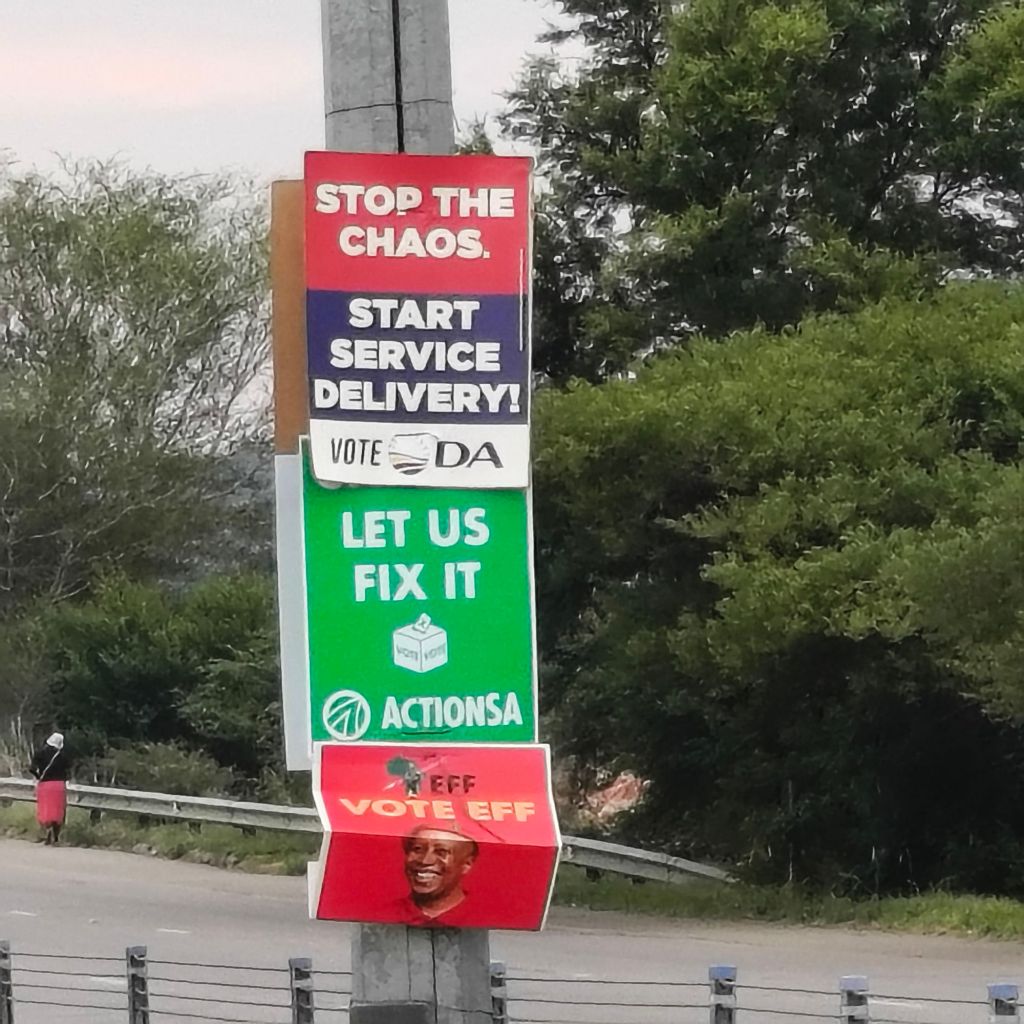
South Africa has finally gone through the much-anticipated November 4th local government elections. This marked elections for local governance which are held once every five years. Local government elections are critical as a pathway for service delivery needs that most South Africans struggle with on a daily basis.
Parts of the country are affected by water cuts and shortages intermittently; this I have personally witnessed as an issue in Soweto and some parts of Southern Johannesburg. Potholes are a concern for most motorists at major roads and the overall state of our roads in parts of the country is concerning. The North West Province and township areas across the land, come to mind. Let me not get started on the quality of drinking water from the taps in Rustenburg -we live on filtered water or refilling water in stores using water containers as a norm this side of the country.
For the next couple of days, news bulletins in Mzansi will be inundated with election news updates and live cross-overs to the various Results Operating Centres (ROCs) across the country and the main hub which is located at Gallagher Estate in Midrand. Normal news will resume once the results are finalized – I’ve made peace with this. I am sure the word ‘trickling‘ will be the most used one by journalists and news anchors across the country as the results are being captured and finalized. I hope the journalists will get their much-needed rest and sleep as soon as the results are declared. The amount of exceptional coverage of the local government elections from the various media houses is commendable – both leading up to and post the election day.
Polls and projections
It’s interesting how there are many polls around seeking to serve as the source to projections on what the final outcome pf the elections, could be. Granted there is some form of research and science to this, but these are in no way definitive, particularly at this stage. These do provide some insight and indications. I am cautious of calling the polls or projections as truthful, this early into the counting process. The declaration of the results will provide insight into whether the various polls and projections we are flooded with, are correct or not. We will wait and see.
What is also interesting to observe is the answer to these questions. Is the noise on social media and on various public platforms indicative of the results we are currently seeing? Is the ruling party being punished or is it too soon to tell?
Free and fair elections
I do trust that the Independent Electoral Commission (IEC) is doing their utmost to ensure free, fair and credible elections through how the elections were conducted and how now, results are captured and reported. This is important in preserving the democracy and integrity of these elections. I commend their strict rules and how they have been able to respond to reported cases of breaches or suspicious cases as and when they are brought forth. Also interesting to note how this time in South Africa coincides with midterm elections in The United States of America and the democrats have recorded impressive wins.
Campaigning
For months now, our street poles have been inundated with placards, our TV/radio stations and social media platforms have not sparred either with political messaging or rhetoric. Some parties have put some effort, more than others, though albeit resources and capacity constraints. Smaller parties suffer the most than larger parties on finding to boost their campaigns. What I have observed with interest, is how the opposition parties have all put on a noteworthy effort in putting forth their preferred candidates to the public in time, something the ruling party has failed to do. I can tell you the candidates for the Democratic Alliance (DA) and Freedom Front Plus (FF+) in Rustenburg’s Ward 17 where I voted based on the marketing that was done. I do not know them personally or otherwise, but I am familiar with them based on the posters I have seen. I also believe it is important for political parties to begin their campaigns early and to be clear from the onset to provide the electorate an opportunity to get to know beforehand, the candidates who are pre-selected and who may occupy public office following the elections. This goes a long way in contributing to voter education – who is the ward councillor for a specific ward is a question worthy of an answer before a complaint can be lodged. It is important that the public know who these possible candidates are beforehand.
Our electoral system in South Africa does not easily enable the public to select their preferred candidates to take on public office, as it is still largely, a party-political system. It gives the public the ability to vote in a political party into power and then that elected party has the choice of who gets to occupy the leadership posts. There have been some noted strides that enable independent candidates to take a stab at the elections, and many have courageously taken on this task on this election. I salute them for believing in themselves and for embarking on this journey alongside the giants. Historically, these independent candidates do not do well. I wait to see how they do this time around. The ruling party is said to have run an unimpressive campaign this year, with no mayoral candidates in their placards – this is noted for most metros, which are hotly contested. Is there a reason behind this? Their campaign posters only used the image of the president as the main draw card. I also didn’t hear much of their usual door-to-door campaigns that are religiously done and I wonder what the reason behind this was. These are what we have grown used to leading up to elections. All political parties did make grand statements at various gatherings across the country, which I feel, make up for the lost momentum somehow.
Election day
The day itself was sunny in most parts of the country, gloomy in parts but proceeded without major hiccups. The news report of some isolated incidents including a woman passing away while waiting to vote in Durban and man shot dead outside a voting station in Bushbuckridge are however concerning and tragic, Tragic as these are, my belief is that the majority of the day went on without significant violence, harm, victimization or intimidation.
Voter apathy
Although the IEC has announced that an impressive 15.9 million South Africans have cast their votes in these elections, there are some noted areas of concern. The IEC reports that over 29 million South Africans registered to vote in the elections. This equates to a 55% turnout that leaves 45% out, who chose to stay away. This is deeply concerning for a democratic state that is home to over 60 million inhabitants according to the latest figures as reported by Statistics South Africa. Taking into account the number of people who went out to vote over the estimated population of the country, the 2026 local government elections will represent an overall 25% of the total population. This is a deeply concerning finding. What researchers, the IEC and political parties ought to go back and dissect is the root cause for this contingent that is choosing to stay away and not be part of the democratic process altogether.
IEC interventions and outlook
The IEC together with the political parties must go back to the drawing board to unpack reasons for this 25%. There is a need to establish the root cause to why people are choosing to stay away. Not speculations but actual quantifiable reasons. Are South Africans so fed by with up politics that they see not point in showing up to vote anymore? Are there any other reasons preventing people from voting beyond this perceived, general perspective that we may not be aware of? Are South Africans so fed up with politics and the lack of service delivery that they see no point in having their voices heard? What is your honest take on this?
The IEC and the various political parties need to come up with ways to better encourage the public to come out in numbers to exercise their rights. One other perspective may allude to staying away as a political statement made in defiance. The Constitution of the Republic also encourages anyone to open and register a political organization or party and to get people to associate with political parties of their choice. This has seen a staggering 508 registered political parties as indicated by the IEC. The ballot papers are getting longer, making the choices more assorted. This is good for democracy but perhaps this could also be a reason for why people stay away – Who do I vote for as all these parties are the same and do not resonate with me? I have heard this statement in many of my personal circles, could this be another valid reason behind voter apathy?
The splitting of the vote share away from the majority is also made possible by the plenty of choices on the table. Do the many political parties talk to democracy or greed for power and lack of strategic collaboration in our political leaders?
What the election results from the previous general elections have shown is how political parties now need to work together to collaborate and share ideas, be in agreement first before the implementation of laws and passing of bills or motions. This is made possible through coalition governments that are seen at both national and provincial levels of government. 2024 marked a first in our democracy – a national government of coalition that was made possible when no party gained outright majority. Whether the governments of coalition at national or provincial levels are successful or not – time can only tell. But as the results continue to trickle in, what may be a continuous reality is the emergence of coalitions even at local government following the declaration of the results.
Coalitions should not be about personalities, egos and power struggles – negotiations should never be done on bad faith but done with the interests of South Africans in mind and with the goal of improving service for all South Africans.
Did you vote in these elections or did you stay away? If you did not vote, I would really like to know your reasons for choosing to stay away.
Reference

